From the archive
The Illusion of Permanence
January 15, 2026·4 min read·Dr. Margie Warrell
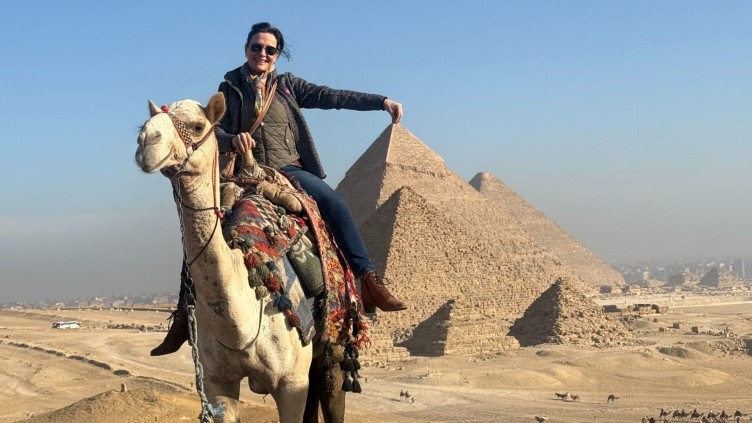
Thirty years ago, I backpacked around Egypt and the Middle East—armed with a few traveler’s checks and wide open to whatever the future might hold.
Two weeks ago, I returned with my husband and two of our children, now the same age I was then. As I rode a cantankerous camel past the Giza pyramids (which were already 2,500 years old when Cleopatra ruled Egypt and Jesus walked the earth), I was struck by how quickly life moves forward. Was it really over half my life ago?!

More than that, I was reminded how easily we lose perspective on time—on the blink-of-an-eye brevity of our lives against the long march of history—and how naturally we assume things are more permanent than they actually are.
This is as true for us individually as it is collectively.
The pharaohs built monuments to permanence, assuming their empires would endure forever. They were wrong. But not because they lacked intelligence or ambition, but because every generation is vulnerable to the illusion of permanence—convincing itself that its power, success, and systems will last longer than they do. And the illusion of permanence becomes even more dangerous when the pace of change outstrips our capacity to make sense of it.
Such is the moment we are in right now.
Change is happening faster than we can integrate it.
Today’s leaders aren’t just navigating immense disruption—we’re doing so without the time or space to pause, reflect, or recalibrate. Psychologists call this temporal compression: too much change, too fast.
It’s not that life itself is moving faster. It’s that our cognitive bandwidth to make good decisions is reduced.
While ancient Egyptians planned in centuries, leaders today are forced into quarter-by-quarter survival cycles. Sustained time pressure activates the brain’s threat response, reducing cognitive flexibility and long-term thinking. Under chronic urgency, we become more risk-averse and less creative—precisely when adaptability matters most.
Change threatens how we see ourselves
But here’s the deeper problem – fear doesn’t just make us more cautious, it narrows our identity. Under pressure, we begin to define ourselves by what feels safest and most familiar: our title, our expertise, our past wins. As identity contracts around what has previously earned approval, security, or status, the status quo starts to feel like self-preservation.
Even when we can intellectually see that change is necessary, loss aversion—the brain’s tendency to prioritize avoiding loss over pursuing gain—keeps us clinging to familiar roles, systems, and structures far longer than is rational. Little wonder it’s so easy to find leaders operating from a play-not-to-lose rather than a play-to-win mindset.
Letting go of the status quo toward something new doesn’t just feel scary. It can feel like we’re losing a part of ourselves.
That’s why what keeps us from adapting isn’t a lack of intelligence or insight—it’s a deficit of courage in the face of increasing fear that we’ll lose ourselves if we stop doing what once worked. This is why expanding our capacity to process fear and act in its presence—closing our internal ‘courage gap’—is so critical right now.
While humanity has evolved, our human struggles haven’t
Humanity has advanced immeasurably since the era of the pharaohs. Yet we’re still wrestling with the same fundamental fears – of loss of status, of irrelevance, of the unknown. The parallels write themselves:
- Pharaohs → CEOs
- Scribes → Knowledge workers
- Temples → Organizations built to signal power and permanence
Context evolves. Psychology doesn’t.
We must choose to step toward the uncertainty
Back in the early 1990s, as I marveled at the imperceptibly slow moving sands of the Sahara that gradually consume villages, I had no cell phone, no email, no social media. There was none. I used to record my adventures on cassette tapes I mailed home to mum. I could scarcely have imagined back then how much the world would change, much less the life ahead of me, in the decades ahead.
As stark as that contrast is with today, I’m certain that thirty years from now the world will look radically different again.
And the greatest threat to our ability to thrive—and to lead well—won’t be external. It will be our own internal resistance… our unchecked fear and undeveloped courage.
To adapt and seize opportunity in a world moving ever faster, we must be humble about what we think we know and courageous enough to change before change is forced upon us. We must learn, unlearn and relearn. Not once, but constantly. And the smarter you think you are, the more important this as past success can lure us into “competency traps”—doubling down on past strengths even as the ground beneath us shifts.
Familiarity will almost always feel safer than reinvention in the moment. But walking among the ancient ruins of Egypt reminded me that living and leading well is never about controlling the future. It’s about stepping onto new ground, risking the occasional misstep, and harvesting the learning those missteps offer.
So as you begin this new year, I invite you to pause and ask:
Where do I need to step toward something new—even when a part of me would much rather stay with the familiar?
And perhaps the more important question:
What do you put at risk if you don’t?